
Sometime in May 1986, Japanese arcades saw the release of a brawler called Nekketsu Koha Kunio-kun (roughly meaning Hot-Blooded Tough Guy Kunio in English). It stars Kunio- a miscreant high schooler fighting for a classmate being picked on by rival gangs. The game is notable for being the first brawler to feature an urban setting and introduced many trademarks common to the genre- a tough guy protagonist, themes of street justice, generic thugs, female villains, and so on. The game underwent significant revisions for its Western release and subsequent NES port, including a name change to Renegade and the story wholly disconnected from its source material.
In this game, you are Mr. K- a regular guy harassed by street gangs for no apparent reason. Beyond simple punches and kicks, he has a variety of moves at his disposal, including collar grabs, shoulder throws, punching downed enemies, and attacking adjacent thugs when an enemy has him in a hold. He wasn’t looking for trouble, but trouble sure was looking for him. Not being one to back down from a fight, he decides it’s time to put these punks in their place- Mr. K’s way.
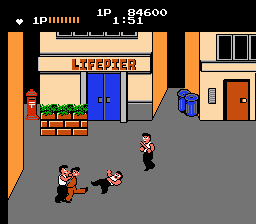
Renegade exudes a strong ‘50s greaser vibe. The rock and roll themes in most levels pair nicely with the game’s setting - especially considering the Japanese original’s thematic element of high school delinquency. In addition, the game is pretty realistic in its portrayal of how a street fight would go down. The thugs you battle don’t just politely stand there waiting for you to gain the upper hand. Instead, they’ll quickly surround you, requiring your constant awareness of their positioning on either side.
After you defeat a foe, another one soon jumps into the fray. When fighting a boss, you have to whittle down their life bar before performing some of your fancier moves. Otherwise, they’ll either push you away or surprise you with a reversal of whatever you were trying to do.
The controls may initially take some time to learn. The function of the A and B buttons are specific to the direction your character is facing. For example, when facing the right, The A button is your punch and the B button kicks. But when facing the left, the attack functions are reversed. Also, your character automatically turns toward the nearest enemy. While it may be a bit confusing at first, the controls work well once you get acclimated. With a bit of practice, you’ll be able to throw punches at the enemy in front of you while kicking the other guy (or gal) attacking from behind, in addition to the other moves mentioned above.
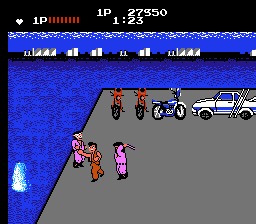
Renegade also features an early example of interactive environments in a fighting game. Stages one and two take place on raised platforms. If you can manage to kick or throw an enemy over the edge, they’re gone for good. Of course, the same applies to Mr. K too, so fighter beware. However, when used skillfully, the environments can work to your advantage and save precious seconds on the clock.
For all of its good qualities, Renegade is hampered by spotty collision detection. Your attacks don’t always connect the way they should; meanwhile, the enemy can easily land punches in quick succession. Therefore, trying to attack by simply walking up to an enemy on the same horizontal plane is a tremendously risky move. Thugs are constantly swarming you and there’s no recovery time between hits or knockdowns. This can easily lead to situations where you’re hopelessly stun-locked if you don’t quickly put some distance between yourself and the enemy after taking a hit.
The game has a rather esoteric power-up system that involves performing certain moves at precise moments in sync with the timer. For instance, you can gain a health replenishment item only after you kick a wall when the last two digits of the timer are a specific number, which also changes depending on the stage you’re on. Similar rules apply to other items that boost Mr. K’s attack power in some way. It’s an interesting gameplay mechanic in theory, but also highly dependant on the player having an instruction manual handy to know how to get these power-up to appear.
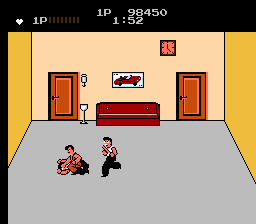
Overall, Renegade is a competent game in its own right. In a sea of imitators, it stood out as a true originator. The gameplay elements have since been copied or paid homage to in the plethora of brawlers that followed. The lack of balance due to uneven collision detection and an arcane implementation of assistive power-ups puts a slight dampener on enjoying the game. But at a mere four stages in length, the game at least respects your time, making its deficiencies less of a slog to endure.
And besides, without Renegade, there would be no River City Ransom- a game that more than made up for the faults of this one. If you’re looking to own Renegade, it’s currently available as part of the Double Dragon and Kunio Kun Retro Brawler Bundle on the Switch and PS4. A no-brainer purchase if you’re a fan of Technos brawlers.
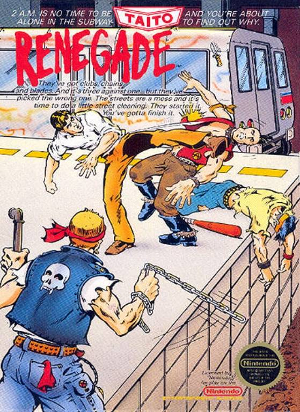

Renegade seemed to be pretty popular when I was a kid. I saw it in a few arcades anyway. I was never a big fan of it, but I love the history behind it and how it ties into Kunio and Double Dragon. And aside from River City Ransom, if we didn't have Renegade, we also wouldn't have had Super Dodge Ball. That was my all-time favorite sports game all the way up until when Wii Sports came along.
Here's my review of the Kunio-Kun and Double Dragon collection you mentioned:
No special screen at the end of that longplay. Kinda weird. I like the variety of moves the character can do: hits them when they're down, rush attack, hands and feet, throws. I noticed the character sometimes gets powered up and the enemies go flying. Neat game.
I remember the print ads for this game. Pretty sophisticated fighting mechanics for the mid 80s.