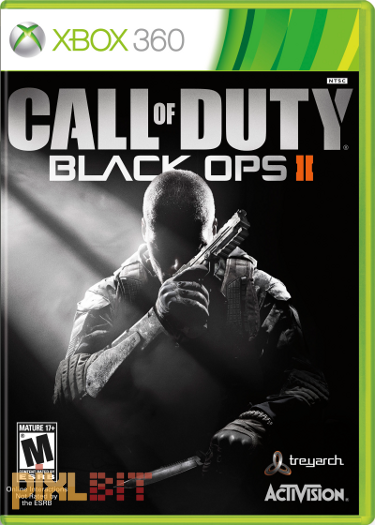
With Call of Duty coming out every November like clockwork and a slew of shooters jumping on that “modern warfare” bandwagon it can be easy to succumb to shooter fatigue. That doesn’t mean I can borrow a page from classic gaming history and turn in a review that reads “just another shooting game” though; each Call of Duty game brings something to the table that’s worth talking about. Call of Duty: Black Ops 2 moves the franchise forward in some ambitious ways, but it’s held back by the very structure the series is known for.
Let’s get things out of the way right off the bat: Black Ops 2 features the same great multiplayer that the series is known for. By this point in the console cycle you’ve most likely already hitched your cart up to this horse, or some other shooter franchise. If it’s the former you know what to expect, and if it’s the latter there isn’t anything here that’s going to sway you over to the COD camp. I’m not a big multiplayer guy, and when I do jump into the realm of playing with “other people” I’m going to gravitate towards more forgiving games like Halo. Call of Duty: Black Ops 2 continues that steady drip of reward and achievements that has become the norm since Call of Duty 4, so if those elements appeal to you and you don’t mind climbing that ladder once again, have at it. That’s not why Black Ops 2 interests me, and I want to be up front about that.
What interests me about Black Ops 2 is the focused narrative and bold new additions to the traditional COD formula. For a long time, Treyarch was considered the “B” team for the Call of Duty franchise, keeping the seat warm while Infinity Ward cooked up the next major release. Things have started to shift, however, and Black Ops 2 cements—at least in my mind—Treyarch’s position as a studio to pay close attention to.
Black Ops 2 tells a split narrative, switching between the near future (2025) and a series of flashbacks as Woods from the first Black Ops tells the story of how he and Alex Mason went on a hunt for a man named Raul Menendez. It’s an interesting perspective change, showing the rise to power of Menendez in the 80's and his attempt to put all of his well laid plans into action in 2025 as he takes aim at Alex Mason’s son, David. Instead of the rapid shifting between multiple characters through various military branches seen in the Modern Warfare series, Black Ops 2 keeps things tight, instead focusing on just a few players. This gives Treyarch room to give these characters weight and motivation, simultaneously showing the shades of grey in military life as well as the brutal realities of war.
Naturally, between these story bits you’re going to shoot a lot of dudes in a plethora of ways. You’ll shoot dudes from behind cover, from horseback, from helicopter, and more. Call of Duty has refined the feel of first person military action, with the same highs and lows. Few can stand up to the frenetic set pieces of the COD series, and as long as you’re pushing forward and taking out the enemy it can be an impressive spectacle.
Once you die a few times and see those same set pieces unfold the same way each time, or step too far out of the tightly scripted path Treyarch has laid out for you, the magic wears off. At times, Black Ops 2 feels like an amusement park ride that will carry me through to the end with little need for interaction from me as the player. As long as I stay on the path and do things the way I’m expected to, the game’s a blast, but too often I’d see a failure screen because I didn’t follow the guy I was supposed to follow closely enough, or heaven forbid I moved to the left when I was supposed to move to the right.
This tight scripting—always a double-edged sword for the series—starts to detract from one of the coolest new elements to the game. Black Ops 2 has a branching storyline that go in some wildly different directions based on your actions and performance in the missions. These decisions aren’t always as binary or clear as “Press X to kill, or press A to capture”, and that was a refreshing thing to see. Oh, there are some of those choices to be made, but many of the places where the game splits may be based on things such as getting enough intel in a mission, or chasing down a target before he can get away with the precious cargo you’ve been tasked to acquire. It’s amazing to see a game that not only allows for you to mess up sometimes, but has entire dialogue and cutscenes ready to take you into a different direction.
The problem with this is of course the fact that Call of Duty has spent so many games teaching players to stay on the path and move forward that it can be totally unclear when you’re given more freedom to do things your own way. My reaction to the first “failure” in a mission was an incredulous “I didn’t know that was an option!” It’s a unique way of getting the story across, and I’m curious to go back and explore some of the paths I didn’t see. It’s just a shame that people are likely to not realize this is in the game until after the fact.
Tying into the branching story paths are the new Strikeforce missions. These are entirely optional missions that can be tackled for a limited amount of time between story sorties, and are best enjoyed right away. Just like the main missions, your success or failure in Strikeforce can have repercussions in the overall story. I was even able to undertake a Strikeforce op to try and rectify one of my screw ups in the core story, and it would be interesting to see how things would have played out had I failed a second time.
The way Strikeforce ties into the narrative is great. The actual Strikeforce missions, on the other hand, could use some work. These missions are basically played in the standard first person style with some light real time strategy elements bolted onto the existing framework. At any time during the mission, you can go into an overhead command view to see the entire battlefield. From here, you can issue orders or take control of a specific unit.
That’s how it works in theory, anyway. Strikeforce seems like a half-baked idea that could have used more time in the oven, sure to be nice and toasty brown in time for Black Ops 3. Units seem to stand still until ordered, but that’s easier said than done. I ended up just selecting “move all” towards the objective, hoping for the best as I controlled a unit directly. Strikeforce gets points for taking place entirely in 2025 with all the cool new weapons and gadgets that Treyarch cooked up for the future era. As it stands, Strikeforce is a quasi-frustrating mode that would be worth skipping if it wasn’t for the relation to the story.
I keep coming back to Black Ops 2 in my thoughts even though the campaign is over. I really think that Treyarch is on the right track for the series, infusing some bold narrative choices into a series that would sell millions of copies with a slapped together, phoned in single player mode. Even though some of the best bits are hamstrung thanks to the aging Call of Duty engine—and aging consoles—the more personal story set against an outrageous terrorist attack really worked for me. Treyarch knows when to dial things back a bit, allowing those crazy, action-packed missions to breathe. I can only hope that they continue in this direction, and I’m now anxiously awaiting what they do with Call of Duty when new hardware finally comes out.
Black Ops 2 is much more than just another shooting game. It represents the “B” Call of Duty team stepping up and trying something new with the series. While it stumbles in places, I’m far more interested to see what happens in 2025 with Treyarch’s next game than what comes out of Call of Duty a year from now. The branching story objectives are a welcome addition to the series, but probably need another game—and possibly another generation of consoles—to really move the franchise forward.